
Solar Generator for a Refrigerator: What Size Do You Need?
Short answer: yes, a solar generator can run a refrigerator, as long as four numbers line up: its continuous output covers the fridge's running watts, its surge rating covers the compressor's startup spike, its battery holds enough watt-hours for the time you need, and (for long outages) its solar input can refill what the fridge uses.
For a typical modern full-size refrigerator, that usually means a unit with roughly 1,500–2,000 Wh of battery for one day of backup and an inverter with a surge rating well above 1,000 W. Add a freezer or other loads, or plan for multiple days, and the numbers climb. Your refrigerator's own label will tell you far more than any generic chart, and the rest of this guide shows you exactly how to use it.
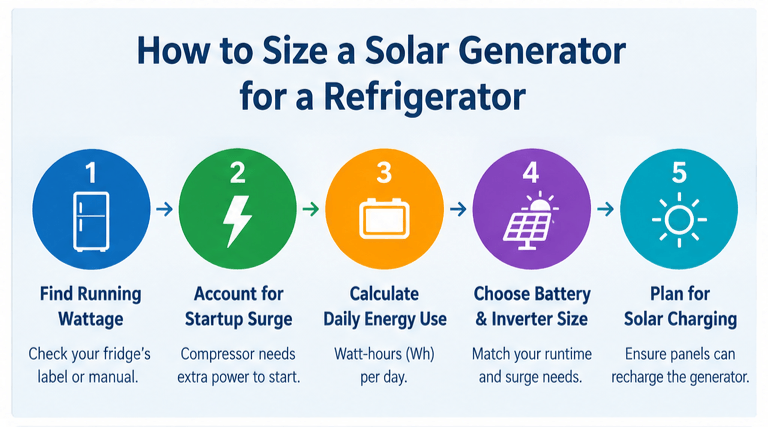
Running a refrigerator from a solar generator is a sizing problem with five parts: running watts, compressor startup surge, usable watt-hours, runtime, and recharge capability. Get those right and the answer becomes a calculation instead of a guess.
Note: all wattage and runtime figures below are planning estimates, not guarantees. Refrigerators vary widely by age, size, and efficiency.
Refrigerator Solar Generator Calculator
Enter your appliance numbers to estimate battery size, inverter needs, runtime, and solar panels. Uses the same method as the guide above.
Your estimate
- Refrigerator per day
- -
- Freezer per day
- -
- Essential loads per day
- -
- Total per day
- -
- Energy for backup period
- -
- Average draw over 24 h
- -
- Continuous output to exceed
- -
- Surge output to exceed
- -
- Runtime on your test battery
- -
- Panels to offset one day
- -
- Your panels' daily harvest
- -
Planning estimates only, not guarantees. Daily Wh = annual kWh ÷ 365 × 1,000. Recommended battery = energy needed ÷ usable %. Continuous output adds running watts of everything that could run together; surge assumes the largest single startup plus everything else running. Panel need = daily Wh ÷ conversion efficiency ÷ (sun hours × real-world %). Confirm your unit's surge rating and solar-input limit on its spec sheet.
Can a Solar Generator Run a Refrigerator?
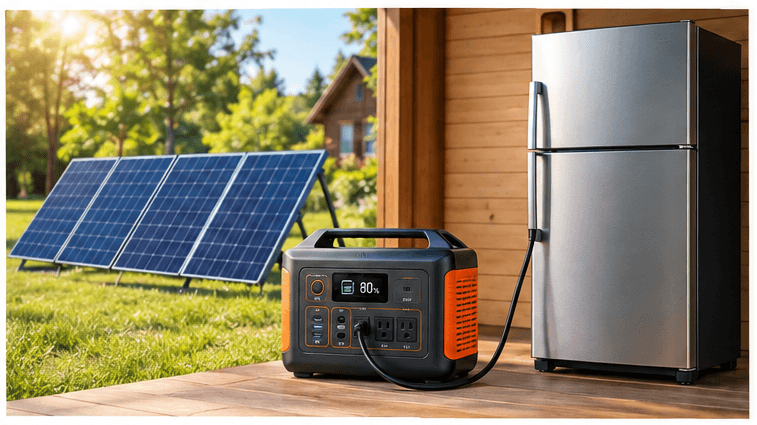
Yes. Many solar generators (also sold as portable power stations) can power a refrigerator during an outage or off-grid, provided the unit is sized for it.
Refrigerators are trickier than lights or phone chargers because they contain a compressor, a motor-driven pump that switches on and off to hold the temperature. A compressor draws a brief burst of extra power when it starts. If the generator's surge rating can't cover that burst, the fridge may fail to start even when the battery is full.
If you want a refresher on how the battery, inverter, and solar input work together, see our explainer on how a solar generator works.
What Size Solar Generator Do You Need for a Refrigerator?
Quick answer: for one day of backup for a modern full-size refrigerator, plan on roughly 1,500–2,000 Wh of battery capacity and a surge rating comfortably above the fridge's startup draw. Small fridges need less; fridge-plus-freezer setups and multi-day outages need more.
There is no single "right" size, and anyone who tells you "you need exactly a 2,000 W unit" is skipping steps. The correct size depends on:
Your refrigerator's running wattage
Its compressor startup surge
Its daily energy use
How long you need backup
The battery's usable (not just rated) capacity
Inverter and conversion losses
Anything else running at the same time
Solar charging conditions and the unit's solar-input limit
Whether a freezer is also connected
For a broader walkthrough that covers every appliance, our solar generator sizing guide uses the same method. This page applies it to one appliance in more depth.
Watts vs. Watt-Hours: The Terms You Need
| Term | Plain-English meaning |
|---|---|
| Watts (W) | How much power something draws *right now* |
| Watt-hours (Wh) | Energy used or stored over time (watts × hours) |
| Kilowatt-hours (kWh) | 1,000 Wh; the unit on your fridge's EnergyGuide label |
| Running watts | Draw while the compressor is actively running |
| Startup/surge watts | The brief, higher draw when the compressor starts |
| Battery capacity | Stored energy, in Wh or kWh |
| Inverter continuous output | The most power the unit can supply steadily |
| Inverter surge output | Short-burst power available for startup loads |
| Solar input | The maximum solar charging power the unit will accept |
Think of watts as the size of the pipe and watt-hours as the size of the tank. A fridge needs a pipe big enough for its startup spike and a tank big enough for the hours you need.
How Much Power Does a Refrigerator Use?
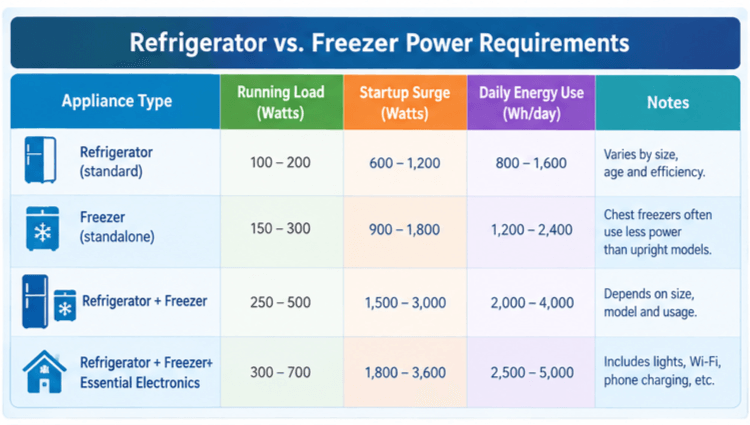
Quick answer: most modern full-size refrigerators draw roughly 100–250 W while the compressor runs, but they use that power only part of the time. Daily energy use typically lands around 800–1,650 Wh, based on the common 300–600 kWh-per-year range.
Refrigerators are "on" all day but cycle. The U.S. Department of Energy notes that refrigerators cycle on and off to maintain temperature and suggests dividing plugged-in time by three to estimate how long one operates at its maximum wattage. That's a rough rule of thumb, and it has a catch: the wattage on a nameplate is often a maximum, not what a modern fridge typically draws. Multiplying a 700 W nameplate by 8 hours gives a number several times higher than what most efficient refrigerators actually use.
A better method is to use the annual kWh on the EnergyGuide label (or the model's listing in the DOE refrigerator and freezer energy rating search tool) and convert it:
Daily Wh = annual kWh ÷ 365 × 1,000
Published ranges vary by source, but one analysis of ENERGY STAR-certified full-size refrigerators found an average of about 493 kWh a year, which works out to about 56 W averaged over 24 hours, or roughly 170 W while the compressor is running (BKV Energy). Compact ENERGY STAR models are commonly listed at roughly 100–470 kWh a year (NRG). Older or very large units can use much more.
| Appliance Type | Typical Running Load | Startup Consideration | Typical Daily Energy | Planning Notes |
|---|---|---|---|---|
| Mini / compact fridge | ~50–100 W | Often ~150–300 W | ~300–1,300 Wh (100–470 kWh/yr) | Easiest to back up; many small units can handle it. |
| Modern full-size fridge | ~100–250 W while compressor runs | Often ~800–1,200 W or more | ~800–1,650 Wh (300–600 kWh/yr) | The most common case; surge rating matters most. |
| Older or very large fridge | ~250–700 W (nameplate may be higher) | Can exceed 1,200 W | ~1,650–2,200+ Wh (600–800+ kWh/yr) | Check the label; very old units can use far more. |
| Chest freezer | ~100–400 W | Similar surge pattern to a fridge | ~575–1,000 Wh (about 210+ kWh/yr) | Well-insulated; loses cold slowly when closed. |
Planning ranges only. Daily Wh = annual kWh ÷ 365 × 1,000. Surge figures vary by model; check the manual or manufacturer.
Why Refrigerator Startup Surge Matters
Quick answer: startup surge is the brief spike in power a compressor draws when it switches on. A solar generator must be able to deliver that spike, so its surge rating matters as much as its continuous rating.
Picture a fridge that draws 150 W once running. When the compressor kicks on, it may briefly ask for several times that. Published guidance on how large the spike is varies: manufacturer articles commonly cite 2–3× running watts, others cite much more, and household-fridge figures around 800–1,200 W show up frequently. Because there's no single rule, use the number in your fridge's manual or from the manufacturer, and choose a unit with headroom.
Two things to check on the generator's spec sheet:
Continuous AC output must exceed the fridge's running watts (plus anything else running with it).
Surge (peak) output must exceed the compressor's startup demand.
A unit with a large battery but a small inverter can still fail to start a fridge. That's why battery size alone is never the answer.
How Many Watt-Hours Does a Refrigerator Use Per Day?
Quick answer: most modern full-size refrigerators use roughly 800–1,650 Wh per day; small fridges use less, and older or larger ones can use much more.
The formula is Energy (Wh) = Power (W) × Time (h). The trap is assuming the compressor runs all 24 hours. It doesn't; it cycles. Two ways to estimate daily use:
From the label (best): 450 kWh/year ÷ 365 × 1,000 ≈ 1,233 Wh/day.
From running watts (rough): 180 W × (24 ÷ 3) hours ≈ 1,440 Wh/day, using DOE's one-third rule of thumb.
These land in the same neighborhood, which is a good sign. If the two methods differ wildly, trust the EnergyGuide figure or measure your fridge for a day or two with a plug-in power meter (DOE notes monitors are especially useful for devices that don't run constantly, like refrigerators).
How to Calculate the Solar Generator Size for Your Refrigerator
Here is the method in eight steps. It follows the same logic as our general sizing guide, narrowed to refrigerators.
Find the running wattage. Check the nameplate, manual, or EnergyGuide label. Volts × amps also works (for example, 120 V × 1.5 A = 180 W).
Find or estimate the startup surge. Look in the manual or ask the manufacturer. If you can't find it, assume it could be a few times the running watts and pick a unit with margin.
Estimate daily energy. Annual kWh ÷ 365 × 1,000.
Decide how long you need backup. One night? 24 hours? Three days?
Multiply. Daily Wh × days = energy needed.
Add reserve for losses. Divide by 0.8 (the same as adding a 25% buffer) to cover inverter losses, cold weather, battery aging, and door openings.
Check inverter ratings. Continuous output above your combined running load; surge output above the largest startup spike.
Check solar input. If you'll recharge from panels, confirm the unit accepts enough solar wattage (see the recharging section).
Worked example (hypothetical): a fridge rated at 450 kWh/year, needed for 24 hours.
Daily use: 450 ÷ 365 × 1,000 ≈ 1,233 Wh
With reserve: 1,233 ÷ 0.8 ≈ 1,540 Wh
Rounded up to a real product size, that points to a unit in the 1,500–2,000 Wh class, with a surge rating above the fridge's startup draw.
Can a 1,000W Solar Generator Run a Refrigerator?
Quick answer: often yes for a modern fridge, but only for part of a day. "1,000 W" describes output, not how long the unit will last, and you still need to confirm the surge rating.
Output: a 1,000 W continuous inverter typically covers a fridge's running draw (100–250 W) with room to spare. Whether it can start the compressor depends on the unit's surge rating; many units in this class list surge ratings well above their continuous rating, but check yours.
Runtime: a 1,000 W inverter says nothing about battery size. A unit with about 1,000 Wh of battery and a fridge averaging ~51 W runs it for roughly 15 hours before recharge (see Table 3 below).
So a "1,000 W" unit may start and run a fridge, but the battery capacity, not the output rating, determines how long. See the runtime guide for the general math.
Can a Solar Generator Run a Refrigerator and Freezer?
Quick answer: yes, but plan for roughly double the energy and a bigger surge rating. A full-size fridge plus a chest freezer commonly needs on the order of 2,000–3,000 Wh for one day.
Adding a freezer changes three things:
Daily energy adds up. A modern fridge at ~450 kWh/year (~1,233 Wh/day) plus a chest freezer at ~250 kWh/year (~685 Wh/day) is about 1,900 Wh/day before reserve.
Running load can overlap. If both compressors run at once, the combined draw can be roughly 250–650 W.
Startup can overlap. If both compressors start together, the surge can stack. Choose a unit with generous surge headroom (a hypothetical planning target of about 2,000 W or more), and if possible, let them start at different times.
| Load | Running Demand | Startup Consideration | Battery Planning (rated Wh) | Notes |
|---|---|---|---|---|
| Refrigerator only | ~100–250 W | ~800–1,200 W or more | ~1,500–2,000 Wh | Baseline case for a modern full-size fridge. |
| Chest freezer only | ~100–400 W | Similar pattern to a fridge | ~700–1,000 Wh | Keep the lid closed; well-insulated units lose cold slowly. |
| Refrigerator + freezer | ~250–650 W if both run together | Can stack if both start at once | ~2,000–3,000 Wh | Surge headroom matters more than in single-appliance setups. |
| Refrigerator + freezer + essentials | Add ~20–60 W for router, lights, phones | Same as above; small loads add little surge | ~2,500–3,500 Wh | A 24/7 router alone adds ~360 Wh/day at 15 W. |
Hypothetical planning ranges, not guarantees. Battery figures include a ~25% reserve for losses. Confirm your own appliances' labels.
How Long Will a Solar Generator Run a Refrigerator?
Quick answer: a 2,000 Wh unit will typically run one modern full-size refrigerator for roughly a day or a little more; a 1,000 Wh unit for about half a day; a 500 Wh unit for several hours.
Don't just divide battery Wh by the fridge's running watts. That overstates the load (a fridge isn't running its compressor constantly) and overstates the supply (you can't use 100% of rated capacity). Real refrigerator runtime is affected by:
Compressor cycling: average draw is much lower than running watts
Inverter losses: converting battery DC to AC wastes some energy
Standby draw: the unit's own electronics consume a little
Ambient temperature: a hot kitchen or garage makes the compressor run more
Door openings: every open door lets warm air in
Refrigerator efficiency: age and condition matter
Usable battery capacity: typically below the rated Wh, and lower when it's cold
The examples below use the average-draw method with 80% usable capacity. See our solar generator runtime guide for the broader formula.
| Battery Size (rated) | Example Refrigerator Load | Estimated Usable Energy | Approximate Runtime | Important Assumptions |
|---|---|---|---|---|
| 500 Wh | Mini fridge, ~23 W average (~550 Wh/day) | ~400 Wh | ~17 hours | Small fridge; surge usually manageable. |
| 500 Wh | Full-size fridge, ~51 W average (~1,233 Wh/day) | ~400 Wh | ~8 hours | Check surge; many small units can't start a full-size fridge. |
| 1,000 Wh | Full-size fridge, ~51 W average | ~800 Wh | ~15–16 hours | Roughly one night plus part of a day. |
| 2,000 Wh | Full-size fridge, ~51 W average | ~1,600 Wh | ~31 hours | About a day and a quarter; no solar recharge. |
| 2,000 Wh | Fridge + chest freezer, ~80 W average (~1,918 Wh/day) | ~1,600 Wh | ~20 hours | Not quite a full day without recharging. |
| 3,000 Wh | Fridge + chest freezer, ~80 W average | ~2,400 Wh | ~30 hours | Solar recharge would extend this. |
| 3,000 Wh | Fridge + router + lights + phones, ~72 W average (~1,733 Wh/day) | ~2,400 Wh | ~33 hours | See Example D below. |
Assumes 80% usable capacity after inverter and battery losses, steady average load, moderate room temperature, and no solar input. Real results vary.
Can Solar Panels Recharge a Solar Generator While the Refrigerator Is Running?
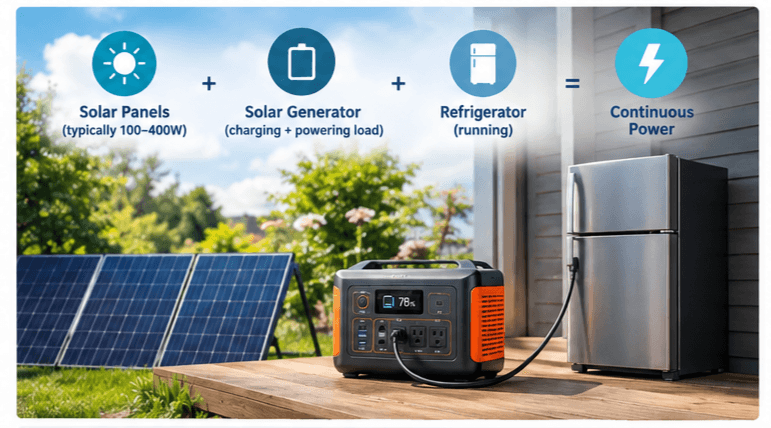
Quick answer: yes, most solar generators can charge and power a load at the same time. Whether the battery stays full depends on how much solar power actually arrives compared with what the fridge uses.
The key idea: a panel's rated wattage is not what it produces most of the day. A "400 W" panel produces 400 W only in near-ideal conditions. Real output depends on sunlight hours, cloud cover, angle, temperature, and how much the unit's solar-input limit will accept. Peak sun hours (a measure of usable sunlight, not daylight hours) vary by location and season; our runtime guide notes that many U.S. locations see roughly 3–6.
Simple example (hypothetical):
400 W of panels × 4 peak sun hours × ~0.75 real-world factor ≈ 1,200 Wh per day of harvest.
A full-size fridge using ~1,233 Wh per day is roughly break-even, before conversion losses.
At midday, if the panels deliver ~300 W and the fridge draws ~180 W while cycling, the surplus (~120 W) charges the battery. At night, the battery covers the fridge.
That's why battery capacity and solar recharging both matter: the battery bridges the night and cloudy hours, and solar refills it.
| Factor | Effect on Charging | Why It Matters | What You Can Do |
|---|---|---|---|
| Solar-input limit | Caps how much panel power the unit accepts | Extra panels beyond the limit are wasted | Match panel wattage to the unit's max solar input. |
| Panel rated wattage | Real output is usually well below rating | Rated watts assume near-ideal sun | Plan on a conservative real-world factor (e.g., ~0.75 or lower). |
| Peak sun hours | Sets total daily harvest | Varies by location and season | Use a conservative local estimate for winter or cloudy spells. |
| Weather / cloud cover | Can cut output sharply | Multi-day outages often coincide with storms | Size the battery to bridge low-sun days. |
| Panel angle & shading | Poor aim or shade reduces output | A shaded corner of a panel can drop output a lot | Face panels toward the sun and keep them unshaded. |
| Temperature | Hot panels lose some efficiency | Affects real-world output | Allow airflow behind panels. |
| Simultaneous load | Fridge draw reduces net charging | Net charge = solar in − load − losses | Reduce other loads during outages. |
Qualitative planning guide. Confirm the solar-input limit and charging behavior in your unit's manual.
Can a Solar Generator Keep a Refrigerator Running During a Power Outage?
Quick answer: yes, for as long as its battery lasts, and indefinitely in good sun if solar input covers the daily use. The refrigerator only helps if it's running before food warms too much.
How it plays out by outage length:
Short outages (a few hours): almost any properly matched unit covers it.
Overnight: a 1,000–1,500 Wh unit typically covers a full-size fridge (see Table 3).
24 hours: roughly 1,500–2,000 Wh for a fridge alone.
Multi-day: battery size alone gets expensive fast; solar recharging becomes the deciding factor.
Food-safety context. USDA's Food Safety and Inspection Service says a refrigerator will keep food safe for up to 4 hours without power if the door stays closed, and a full freezer holds temperature for about 48 hours (24 hours if half full). After 4 hours without power, refrigerated perishables such as meat, poultry, fish, eggs, and leftovers should be discarded (USDA FSIS; FoodSafety.gov). The FDA also recommends keeping an appliance thermometer in the refrigerator and freezer (at or below 40°F and 0°F) so you can judge food safety (FDA).
Two practical takeaways: a solar generator can't undo time already spent above safe temperatures, so connect it early; and keep the doors closed to preserve cold. For a comparison with fuel-based backup for long outages, see solar vs. gas generators.
What Specifications Should You Look For?
The headline watt-hour number is only one line on the spec sheet. Here is what matters for a refrigerator specifically.
| Specification | What It Means | Why It Matters for Refrigerators | What to Check |
|---|---|---|---|
| Battery capacity (Wh) | Total stored energy | Sets how many hours or days the fridge can run | Rated Wh; assume ~80% usable. |
| Continuous AC output (W) | Steady power the inverter can supply | Must exceed the fridge (and freezer) running watts plus other loads | Continuous W above your combined running load. |
| Surge output (W) | Short-burst power for startup | The compressor's startup spike can prevent starting | Surge W above the largest startup demand, with margin. |
| Pure sine wave inverter | Clean AC waveform similar to the grid | Compressor motors generally prefer it; manufacturers recommend it | Confirm "pure sine wave"; follow your fridge manual. |
| Solar input (W) | Max panel power accepted | Determines how fast solar can refill the battery | Solar-input W and voltage/current limits. |
| AC charging speed | How fast a wall outlet recharges | Useful for topping up before an expected outage | Full-charge time from AC. |
| Expandable capacity | Add-on batteries | Lets you grow for a freezer or longer outages | Compatible expansion batteries and limits. |
| Battery chemistry | e.g., LiFePO4 vs. NMC | Affects cycle life and weight over years of backup use | Rated cycle life and operating temperatures. |
| UPS / pass-through | Switches to battery when grid power drops | Convenient for automatic backup of an always-plugged-in fridge | Switchover time; whether it's designed for appliances. |
| Warranty & portability | Coverage length; weight | Heavy units are harder to move; longer coverage helps long-term use | Warranty terms and weight. |
Always verify specifications on the manufacturer's current spec sheet. Ratings vary by model.
A note on pure sine wave: manufacturers of solar generators commonly recommend pure sine wave output for compressor appliances (Anker SOLIX, for example, states this in its refrigerator sizing guide). Your refrigerator's manual has the final word.
When you're ready to compare actual models against these numbers, start with our buying guide.
Solar Generator Size Examples for Different Refrigerator Situations
All examples below are hypothetical planning examples, not tests of a specific product.
Example A: Mini fridge. ~200 kWh/year → ~550 Wh/day. For 24 hours: 550 ÷ 0.8 ≈ 690 Wh, so a ~700–1,000 Wh unit fits. Running ~50–100 W with a ~150–300 W startup, a modest inverter works. Runtime on 1,000 Wh: about 35 hours.
Example B: Standard household fridge. ~450 kWh/year → ~1,233 Wh/day. Running ~150–200 W while the compressor is on; startup ~800–1,200 W or more. For 24 hours: 1,233 ÷ 0.8 ≈ 1,540 Wh, so a 1,500–2,000 Wh unit with a surge rating comfortably above 1,200 W. A 2,000 Wh unit gives roughly 31 hours.
Example C: Refrigerator + chest freezer. ~450 + ~250 kWh/year → ~1,900 Wh/day. For 24 hours: ~2,400 Wh; for two days: ~4,800 Wh. Combined running load ~250–650 W. Target a surge rating of about 2,000 W or more if both could start together. Solar recharging becomes very useful past one day.
Example D: Refrigerator + essentials. Fridge ~1,233 Wh + router (15 W × 24 h = 360 Wh) + LED lights (24 W × 5 h = 120 Wh) + phone charging (~20 Wh) = ~1,733 Wh/day. Divide by 0.8: ~2,170 Wh, so a 2,200–2,500 Wh unit. Notice the router alone uses nearly a third of the fridge's daily energy. Small always-on loads add up, and they also raise the continuous output you need if they run alongside the compressor.
| Scenario | Loads | Battery Consideration | Inverter Consideration | Solar Input Consideration |
|---|---|---|---|---|
| Mini fridge, 24 h | ~550 Wh/day | ~700–1,000 Wh | Low surge (~150–300 W startup) | Optional; a small panel setup may cover daily use. |
| Full-size fridge, 24 h | ~1,233 Wh/day | ~1,500–2,000 Wh | Surge comfortably above ~1,200 W | Needed only if the outage may exceed a day. |
| Fridge + freezer, 24 h | ~1,900 Wh/day | ~2,400 Wh or more | Surge ~2,000 W+ if both may start together | Useful; daily harvest of ~1,900 Wh needs roughly 700–900 W of real panels at 4 sun hours. |
| Fridge + essentials, 24 h | ~1,733 Wh/day | ~2,200–2,500 Wh | Continuous above the sum of items running together | ~600–800 W of panels would roughly offset daily use at 4 sun hours. |
| Extended outage (3+ days), fridge only | ~1,233 Wh/day | Battery to bridge nights and cloudy spells | Same as full-size fridge | ~500 W of panels would roughly cover daily use at 4 sun hours; plan for lower output in poor weather. |
Panel estimates: daily Wh ÷ 0.85 (conversion) ÷ (4 peak sun hours × 0.75 real-world factor). Hypothetical; adjust for your location and season.
Common Mistakes When Using a Solar Generator for a Refrigerator
Choosing based only on watts. Inverter watts don't tell you runtime.
Ignoring surge. A fridge can fail to start even on a full battery.
Confusing W and Wh. One is a rate, the other a quantity.
Assuming rated capacity is all usable. Plan on losses.
Assuming panels produce rated output all day. They don't.
Forgetting other loads. Routers, lights, and chargers add up.
Skipping input/output limits. Check the solar-input and continuous-output caps.
Assuming one size fits every fridge. Your label beats any generic chart.
Frequently Asked Questions
Yes, if its continuous output, surge rating, and battery capacity match the fridge's needs.
For one day with a modern full-size fridge, roughly 1,500–2,000 Wh with adequate surge; small fridges need less, and multi-appliance setups more.
Often yes for running and starting a modern fridge if the surge rating is sufficient, but the battery (often about 1,000 Wh in this class) will last only about half a day.
Commonly about 800–1,650 Wh for modern full-size units (300–600 kWh per year); use your EnergyGuide label for a precise number.
It varies by model; household figures around 800–1,200 W or more are common. Check the manual.
Yes; plan for roughly 2,000–3,000 Wh per day and extra surge headroom.
About 15 hours on 1,000 Wh and about 31 hours on 2,000 Wh for a typical full-size fridge, before solar recharging.
Yes, if the unit supports simultaneous charging and discharging. Net charging depends on real panel output versus fridge draw.
Enough for your desired hours plus about a 25% reserve; commonly 1,500–2,000 Wh for a day with one fridge.
Yes, for as long as battery and solar recharge allow. Keep the doors closed and use an appliance thermometer.
Manufacturers commonly recommend it for compressor appliances. Check your fridge's manual.
It may fail to start the compressor, trip on overload, or run out of battery early.
Final Takeaway
Sizing a solar generator for a refrigerator comes down to a short list of numbers. On your fridge, find the running watts, the startup surge, and the annual kWh (convert to daily Wh). On the generator, check battery Wh, continuous output, surge output, and solar input. Multiply your daily Wh by your backup days, add about 25% for losses, and confirm the inverter ratings and recharge plan.
Once you have your numbers, use our buying guide to evaluate products, or see Best Solar Generators to compare specific models against them.
SOURCES
U.S. DOE, Estimating Appliance and Home Electronic Energy Use: refrigerator cycling; divide-by-three rule; EnergyGuide labels; monitors.
U.S. DOE, Refrigerator and Freezer Energy Rating Search Tool.
USDA FSIS, Keep Your Food Safe During Emergencies: 4-hour refrigerator, 48/24-hour freezer guidance.
FDA, Food and Water Safety During Power Outages and Floods: thermometer temperatures (40°F / 0°F).