
Can a Solar Generator Run a Freezer? Sizing, Runtime & Best Options
Quick answer: yes. A solar generator can run a freezer as long as its inverter can start the compressor and its battery holds enough watt-hours for the outage. An ENERGY STAR certified chest freezer typically uses about 215 kWh a year (roughly 590 Wh a day), and a certified upright about 395 kWh a year (roughly 1,080 Wh a day).
For one day of backup, plan on roughly 700–1,000 Wh of rated battery for a small-to-medium chest freezer and 1,500 Wh or more for an upright, with a surge rating well above the compressor's startup draw. Use the sizing calculator below with your own freezer's numbers.
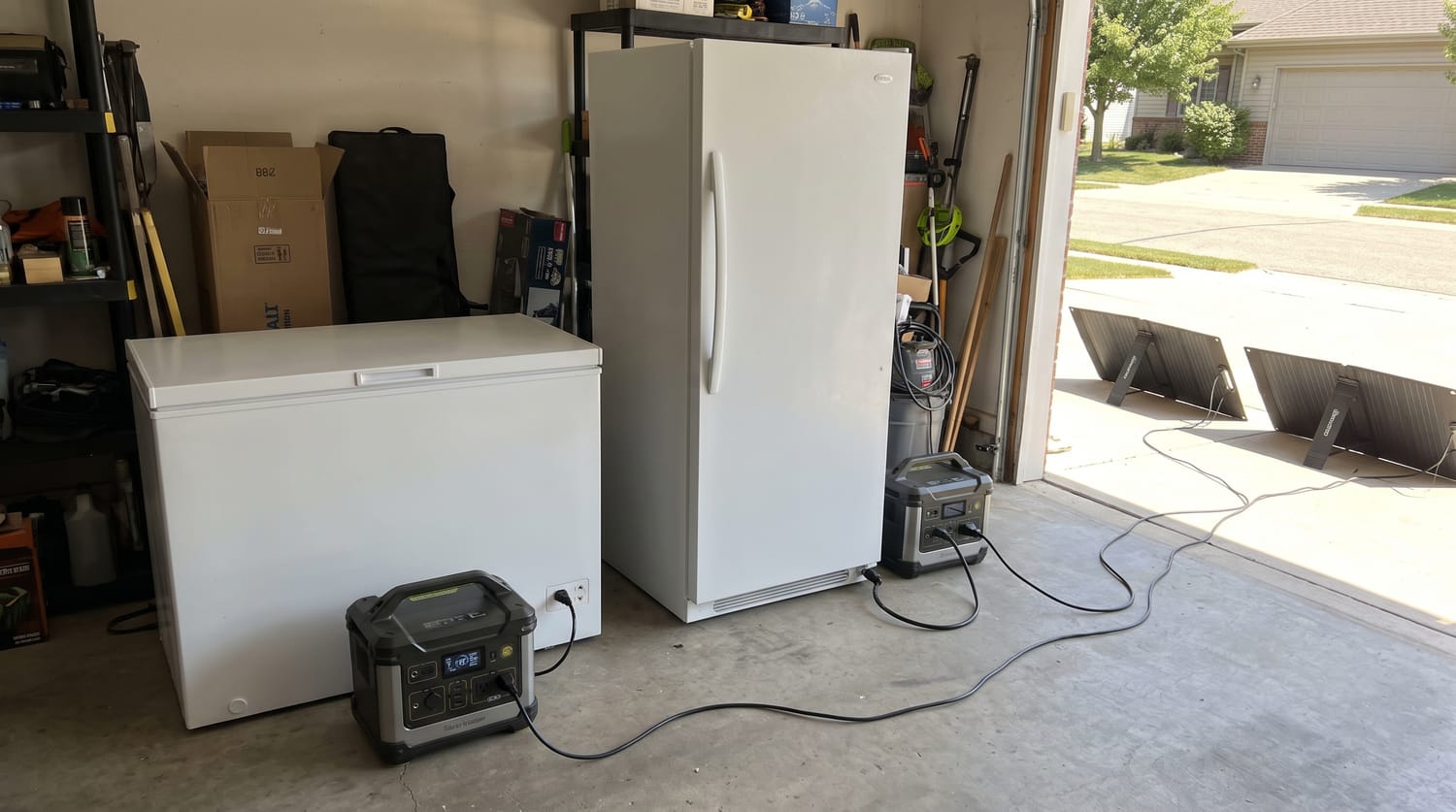
A solar generator for a freezer is one of the more practical options for freezer backup power, because freezers are well insulated and cycle on and off rather than drawing power constantly. The catch is that "can it run my freezer?" is really five questions: how much energy the freezer uses per day, how many running watts it draws, how big the compressor's startup surge is, how much battery capacity you have, and how much solar charging you can add.
This guide answers each one with ENERGY STAR data, worked examples, seven comparison tables and a calculator that does the arithmetic. It focuses on freezers specifically. For a fridge (or a fridge plus freezer), see our solar generator for a refrigerator guide, and for whole-home loads see can a solar generator power a whole house.
Can a Solar Generator Run a Freezer?
Yes. A solar generator is a battery, an inverter and usually a solar charge controller in one box. The battery stores energy, the inverter turns it into household AC power for the freezer, and solar panels refill the battery during the day. If you want a refresher on the parts, see how a solar generator works.
This guide is about running a standard AC freezer from a solar generator, the setup most households already have. Purpose-built DC "solar freezers" (sometimes sold as a solar powered freezer) exist, but they are a different product category and are not covered here.
Chest freezer vs. upright freezer
Chest freezer
Opens from the top, so cold air stays put when you lift the lid. ENERGY STAR certified chest freezers use about 215 kWh a year on average. Many are manual defrost, so there is no defrost heater adding load.
Upright freezer
Front door with shelves, easier to organize, but cold air spills out when the door opens. Certified models use about 395 kWh a year on average, and frost-free versions cycle a defrost heater that adds to the load.
Compact and large deep freezers
Compact units draw the least and are the easiest to back up. Large 20+ cubic foot deep freezers and multi-freezer setups raise daily energy, running watts and startup surge, so size them from their labels (see Section 3).
Why startup power matters
A freezer has a compressor, a motor-driven pump that switches on and off to hold temperature. When it starts, it briefly draws several times its running watts. If the generator's surge rating cannot cover that spike, the freezer may fail to start even with a full battery. Surge figures vary by model, so use your freezer's manual or ask the manufacturer rather than a generic multiplier.
Battery capacity vs. inverter output
These are two different specifications, and mixing them up is the most common sizing error.
Battery capacity (Wh) = the tank How much energy is stored. Sets how long the freezer runs.
Inverter output (W) = the pipe How much power can flow at once, including the startup spike. Sets whether the freezer can start and run.
A big battery with a small inverter can still fail to start a compressor, and a big inverter with a small battery will start it and then run out of energy quickly. You need both.
When a solar generator may not be suitable
Very large, very old or commercial freezers whose daily energy use or startup draw exceeds what a portable unit can supply.
240 V freezers. Many portable solar generators output 120 V, so check voltage before buying.
Multi-day outages with little sun, where the battery alone would run out. A fuel generator or a larger battery bank may be a better fit (see Section 8).
Hard-wired freezers with no accessible plug.
How Much Electricity Does a Freezer Use?
Quick answer: how many watts does a freezer use? A modern freezer uses roughly 600–1,100 Wh a day. It averages only a few dozen watts over 24 hours but draws noticeably more while the compressor is running.
Two numbers matter, and they are easy to confuse:
Annual kWh is on the yellow EnergyGuide label. Convert it to a daily figure: daily Wh = annual kWh ÷ 365 × 1,000.
Running watts is what the freezer draws while the compressor is on. Because the compressor cycles, the 24-hour average is much lower. For a quick sanity check, the U.S. Department of Energy recommends a plug-in energy monitor for devices that don't run constantly.
ENERGY STAR reports that a certified chest freezer uses about 215 kWh a year and a certified upright about 395 kWh a year (ENERGY STAR freezers). Those are averages across certified models of different sizes, so they show the typical gap between styles, not a like-for-like comparison of one capacity.
| Measure | Chest freezer | Upright freezer |
|---|---|---|
| Typical annual energy use | ~215 kWh/year | ~395 kWh/year |
| Daily energy (annual kWh ÷ 365) | ~589 Wh/day | ~1,082 Wh/day |
| Average draw over 24 hours | ~25 W | ~45 W |
| Typical defrost type | Often manual defrost | Usually frost-free (defrost heater cycles) |
| Cold loss when opened | Lower: cold air settles in the box | Higher: cold air spills out of the front |
| What it means for backup | Smaller battery for the same food | Plan for roughly double the daily energy |
Source: ENERGY STAR (annual kWh averages). Daily Wh and average watts are calculated from those figures. Individual freezers vary widely, so use your own label.
Running watts and startup surge
Nameplate wattage is often a maximum, not what a freezer typically draws. Multiplying a nameplate figure by 24 hours will overstate daily energy several times over. The ranges below are planning assumptions, not measurements.
| Freezer type | Typical running watts (compressor on) | Typical startup surge | Planning notes |
|---|---|---|---|
| Compact freezer | ~40–80 W | ~200–400 W | Easiest to back up; most mid-size units start it. |
| Small to medium chest | ~60–120 W | ~300–700 W | Lower daily energy; surge still matters. |
| Large chest / deep freezer | ~100–250 W | ~500–1,000 W | Check the label; older units can draw far more. |
| Upright (frost-free) | ~100–200 W | ~500–1,000 W | The defrost heater is an extra load on top of the compressor. |
| Two or more freezers | Add the running watts | Starts can stack | Plug in one at a time so the compressors do not start together. |
Planning ranges only. Startup draw varies by model, so confirm it in the manual or with the manufacturer. A plug-in power meter gives you the real numbers for your freezer.
What changes a freezer's consumption
Ambient temperature: a hot garage or porch makes the compressor run more often.
Size and insulation: larger freezers use more energy in total, though not always more per cubic foot.
Age and condition: older units and worn door gaskets use more.
Door openings: every opening lets warm air in, and the effect is bigger on an upright.
Fill level: a full freezer holds cold better than a mostly empty one.
Defrost type: frost-free models add defrost-heater cycles.
Technical tip: plug the freezer into a watt-hour meter for 24 to 48 hours in the room where it lives. That one reading replaces most of the guesswork in the rest of this guide.
Food safety context: USDA's Food Safety and Inspection Service says a full freezer holds its temperature for about 48 hours if the door stays closed (about 24 hours if half full). See USDA FSIS guidance for emergencies. A solar generator cannot undo time already spent above safe temperatures, so connect it early and keep the lid closed.
What Size Solar Generator Do You Need for a Freezer?
Quick answer: a solar generator for a chest freezer needs roughly 700–1,000 Wh of rated battery for one day if the freezer is small to medium. A solar generator for an upright freezer or a large deep freezer needs about 1,350–1,500 Wh, and two freezers need about 2,200 Wh or more. In every case the inverter's surge rating must also cover the compressor start.
Four specifications decide the size, and our general solar generator sizing guide uses the same method for any appliance:
Rated battery capacity (Wh): the headline number on the box.
Usable battery capacity: what you can actually draw after inverter and battery losses. Planning on about 80% of rated is a common, conservative assumption.
Continuous inverter output (W): must exceed the freezer's running watts, plus anything else running with it.
Surge output (W): must exceed the compressor's startup draw.
Important: battery capacity alone never determines whether a freezer can start. A 2,000 Wh battery behind a small inverter can fail where a 700 Wh unit with a strong surge rating succeeds.
Step-by-step sizing walkthrough
Find daily energy. Read the annual kWh on the EnergyGuide label (or look the model up in ENERGY STAR or DOE listings), then divide by 365 and multiply by 1,000.
Find running watts and startup surge. Use the manual, the manufacturer, or a plug-in power meter.
Choose your backup time. Multiply daily Wh by the number of days (or hours ÷ 24).
Add a loss allowance. Divide by your usable percentage (0.8 for 80%) to get the rated battery size.
Check the inverter. Continuous output should exceed the running watts of everything that can run together. Surge output should exceed the largest startup spike plus anything already running.
Plan the solar. Panel watts = daily Wh ÷ (peak sun hours × efficiency), and confirm the generator's maximum solar input (Section 5).
Practical sizing scenarios
These are hypothetical planning examples built on annual kWh figures chosen to illustrate each type (ENERGY STAR averages are 215 kWh for chest and 395 kWh for upright). They are not tests of any specific product.
Small chest (~5–7 cu ft)
~180 kWh/yr = ~493 Wh/day. For 24 hours: 493 ÷ 0.8 = ~620 Wh. A ~700 Wh class unit fits.
Medium chest (~10–15 cu ft)
~250 kWh/yr = ~685 Wh/day. For 24 hours: 685 ÷ 0.8 = ~860 Wh. A ~1,000 Wh class unit fits.
Large chest (~20 cu ft)
~350 kWh/yr = ~959 Wh/day. For 24 hours: ~1,200 Wh. Target 1,200–1,500 Wh and a surge rating with headroom.
Upright (~15–17 cu ft)
~395 kWh/yr = ~1,082 Wh/day. For 24 hours: ~1,350 Wh. Target ~1,500 Wh, and mind the defrost-heater load.
Two freezers (medium chest + upright)
~645 kWh/yr = ~1,767 Wh/day. For 24 hours: ~2,210 Wh. Target 2,200–2,500 Wh and stagger the startups.
| Freezer scenario | Daily energy | 24 hours | 48 hours | 72 hours | Inverter consideration |
|---|---|---|---|---|---|
| Small chest | ~493 Wh | ~620 Wh | ~1,230 Wh | ~1,850 Wh | Low surge; most units start it. |
| Medium chest | ~685 Wh | ~860 Wh | ~1,710 Wh | ~2,570 Wh | Confirm surge is well above the label startup draw. |
| Large chest | ~959 Wh | ~1,200 Wh | ~2,400 Wh | ~3,600 Wh | Choose generous surge headroom. |
| Upright | ~1,082 Wh | ~1,350 Wh | ~2,710 Wh | ~4,060 Wh | Allow for the defrost heater cycle. |
| Two freezers | ~1,767 Wh | ~2,210 Wh | ~4,420 Wh | ~6,630 Wh | Running loads add; avoid simultaneous starts. |
Calculated as daily Wh × days ÷ 0.80 usable capacity. Hypothetical planning values; round up to a real product size and add solar to stretch the battery over multi-day outages.
Freezer sizing calculator
Enter your freezer's numbers and the specs of the solar generator you are considering. The calculator uses the same method as the walkthrough above and flags any spec that falls short.
Calculator details (the interactive tool is in the HTML version):
Inputs: freezer type (chest, upright, compact, custom), number of freezers, annual kWh, running watts, startup surge watts, backup duration (hours or days), usable battery %, peak sun hours, solar charging efficiency %, planned solar panel watts, and the generator you are testing (rated Wh, continuous W, surge W, maximum solar input W).
Outputs: estimated daily energy, energy needed for the backup period, recommended rated battery, minimum continuous inverter output, required surge (staggered and simultaneous), runtime on the selected battery, panel watts needed to replace a day's use, daily harvest from planned panels, and pass/warn/fail checks.
Formulas: daily Wh = annual kWh / 365 x 1,000 (or running W x 24 x 1/3 if kWh is blank); recommended battery = energy needed / usable %; runtime = battery Wh x usable % / (daily Wh / 24); panel W = daily Wh / (peak sun hours x efficiency).
Default example (chest freezer, 215 kWh/yr, 90 W running, 450 W surge, 24 h, 80% usable, 4 sun hours, 64% efficiency, 400 W panels, tested unit 1,024 Wh / 1,800 W / 3,600 W / 500 W solar): ~589 Wh/day; ~737 Wh recommended battery; 90 W continuous; 450 W surge; ~33.4 h runtime on the tested unit; ~231 W of panels to replace a day; ~1,024 Wh/day harvest from 400 W. All checks pass.
Results are planning estimates, not guaranteed runtimes.
Freezer Solar Generator Calculator
Defaults are planning estimates, not measurements. Replace them with the numbers from your freezer's label (or a plug-in power meter) and your generator's spec sheet. Results update as you type.
Your estimate
Planning estimates only, not guaranteed runtimes. Daily Wh = annual kWh ÷ 365 × 1,000 (or running W × 24 h × 1/3 if kWh is blank). Recommended battery = energy needed ÷ usable %. Panel watts = daily Wh ÷ (peak sun hours × efficiency). Real results vary with temperature, door openings, freezer age and weather.
How Long Can a Solar Generator Run a Freezer?
Quick answer: a 1,000 Wh unit typically runs a medium chest freezer for about a day plus a few hours, and an upright for about 18 hours, before any solar recharging.
Do not divide battery Wh by the freezer's running watts. That overstates the load, because the compressor only runs part of the time, and it overstates the supply, because you cannot use 100% of rated capacity. Use the average draw instead:
Runtime (hours) = battery Wh × usable % ÷ average watts, where average watts = daily Wh ÷ 24.
Example: a 1,024 Wh unit running a medium chest freezer (~685 Wh/day, about 28.5 W average): 1,024 × 0.8 = 819 Wh usable; 819 ÷ 28.5 = about 29 hours.
Things that move the answer:
Compressor cycling: average draw is far below running watts, which is why runtimes look long.
Battery and inverter efficiency: built into the 80% usable assumption.
Environment: if a hot garage makes the compressor run about 50% more, divide the runtimes below by 1.5. A medium chest on 1,000 Wh drops from ~28 hours to ~19.
Simultaneous solar charging: most units can charge and discharge together, so daytime sun extends runtime. See Section 5 and our solar generator runtime guide.
| Freezer scenario | Average draw | 500 Wh | 1,000 Wh | 2,000 Wh | 3,000 Wh |
|---|---|---|---|---|---|
| Small chest (~493 Wh/day) | ~20.5 W | ~19 h | ~39 h | ~78 h | ~117 h |
| Medium chest (~685 Wh/day) | ~28.5 W | ~14 h | ~28 h | ~56 h | ~84 h |
| Large chest (~959 Wh/day) | ~40 W | ~10 h | ~20 h | ~40 h | ~60 h |
| Upright (~1,082 Wh/day) | ~45 W | ~9 h | ~18 h | ~35 h | ~53 h |
| Two freezers (~1,767 Wh/day) | ~73.6 W | ~5 h | ~11 h | ~22 h | ~33 h |
Assumes 80% usable capacity, a steady average load, moderate room temperature and no solar input. These are estimates, not guarantees, and the inverter must still be able to start the compressor.
How Many Solar Panels Do You Need for a Freezer?
Quick answer: solar power for a freezer works best when the panels can replace one day of use. Plan on roughly 200–430 W of panels for one freezer at 4 peak sun hours, and about 700 W for two. Check that your generator accepts that much solar input.
The method has four parts:
Daily energy to replace: the daily Wh from Section 2.
Peak sun hours: equivalent hours of full-strength sunlight, not hours of daylight. They vary by location and season; NREL's PVWatts calculator gives location-specific data.
Rated vs. real output: a 400 W panel rarely produces 400 W. Angle, heat, shade and conversion losses all take a share. The calculator and tables use a combined 64% efficiency (about 85% conversion × 75% real-world), a conservative planning figure.
Solar input limit: panels beyond the generator's maximum solar input are wasted.
Panel watts = daily Wh ÷ (peak sun hours × 0.64)
Worked examples
Medium chest, 4 sun hours: 685 ÷ (4 × 0.64) = ~268 W, so a 300 W panel setup roughly offsets a day of use.
Upright in a cloudier month, 3 sun hours: 1,082 ÷ (3 × 0.64) = ~564 W. A generator capped at 500 W of solar input could not accept that, so you would lean on a larger battery or accept a partial recharge.
Two freezers, 4 sun hours: 1,767 ÷ (4 × 0.64) = ~690 W, which needs a generator with a high solar input limit.
| Freezer scenario | Daily energy | 3 sun hours (cloudy/winter) | 4 sun hours (typical) | 5 sun hours (sunny) |
|---|---|---|---|---|
| Small chest | ~493 Wh | ~257 W | ~193 W | ~154 W |
| Medium chest | ~685 Wh | ~357 W | ~268 W | ~214 W |
| Large chest | ~959 Wh | ~499 W | ~375 W | ~300 W |
| Upright | ~1,082 Wh | ~564 W | ~423 W | ~338 W |
| Two freezers | ~1,767 Wh | ~920 W | ~690 W | ~552 W |
Panel watts = daily Wh ÷ (sun hours × 0.64). Hypothetical planning values for sunny-day replacement of daily use only; add panel wattage to recharge a depleted battery faster, and plan on lower output in storms and winter.
Multi-day outages often come with storms, so plan on the low-sun column when sizing a system you will rely on. The battery bridges nights and cloudy stretches, and solar refills it when the sun returns.
Best Solar Generator Features for Freezer Backup
Do not choose a unit on advertised battery capacity alone. For a freezer, these features matter most:
LiFePO4 (LFP) battery: generally long cycle life and good thermal stability. Cycle-life figures are manufacturer claims, so compare them against the warranty length. Also check operating temperatures: for example, Jackery lists 32–113°F for charging and 14–113°F for discharging on the Explorer 2000 v2, which matters for a freezer in an unheated garage.
Continuous output: must exceed the freezer's running watts plus anything else on the unit.
Surge output: must exceed the compressor's startup draw. Be cautious about boosted "peak" modes. For example, Bluetti describes its 3,900 W mode on the Elite 200 V2 as intended for resistive loads, and a compressor is not one.
Expandability: extra batteries let you grow from one freezer to two, or from one day to several.
Solar input limit: sets how much of your panel array the unit can actually use.
UPS or pass-through: switches to battery automatically when the grid drops. Check the manufacturer's switchover time and whether it is intended for motor loads.
Battery management system (BMS): protects against over-current, over-temperature and deep discharge.
Warranty and portability: 5-year warranties are now common among established brands, and a 40 lb unit is much harder to move than a 25 lb one.
| Specification | Why it matters for a freezer | What to check |
|---|---|---|
| Battery capacity (Wh) | Sets how many hours the freezer runs. | Rated Wh; assume about 80% usable. |
| Continuous AC output (W) | Must cover running watts of all connected loads. | Continuous W above the combined running load. |
| Surge output (W) | The compressor start can exceed running watts several times over. | Surge W above the largest startup draw, with margin; confirm the mode applies to motor loads. |
| Pure sine wave inverter | Compressor motors generally prefer clean AC. | Confirm pure sine wave and follow the freezer manual. |
| Solar input (W and V) | Determines how much sun you can harvest. | Maximum solar watts and the voltage window of your panels. |
| Expandable capacity | Lets you add a second freezer or more days. | Compatible extra batteries and their limits. |
| UPS switchover time | Automatic backup for an always-plugged-in freezer. | Switchover time and manufacturer guidance for appliances. |
| Operating temperature | Garages and sheds get hot and cold. | Charge and discharge temperature ranges. |
| Warranty and weight | Long-term cost and how easily it can be moved. | Warranty terms (and any registration needed) and weight. |
Always verify specifications on the manufacturer's current spec sheet; ratings vary by model and by region.
Recommended Solar Generator Options for Freezers
The four units below come from established brands, list the specifications a freezer needs (a real surge rating, a LiFePO4 battery and a published solar input limit), and cover the sizes in the scenarios above. Everything in the table is manufacturer or retailer-published data. We have not tested these products ourselves, and where independent reviews exist we link to them as the reviewers' findings, not ours. For fuller write-ups see our reviews of EcoFlow, Jackery, BLUETTI and Anker, and the wider best solar generators comparison.
| Model | Battery | Continuous / surge | Solar input | Expandable | Warranty | Price seen | Best fit |
|---|---|---|---|---|---|---|---|
| EcoFlow DELTA 3 Plus | 1,024 Wh LFP | 1,800 W / 3,600 W | Listings cite 500 W per input; some show up to 1,000 W (verify) | Yes, via EcoFlow extra batteries | 5 years | ~$649–$759 | Small to medium chest, 24 h |
| Jackery Explorer 2000 v2 | 2,042 Wh LFP | 2,200 W / 4,400 W | Up to 400 W per retailer listings (verify) | Not confirmed; check Jackery | 3 years + 2 free (jackery.com) | ~$799–$899 | Upright or large chest, about a day |
| BLUETTI Elite 200 V2 | 2,073.6 Wh LFP | 2,600 W / 3,900 W (resistive-load mode) | 1,000 W max (12–60 V) | No | 5 years | ~$899 (sale listing) | Upright or two freezers, about a day |
| Anker SOLIX F2000 | 2,048 Wh LFP | 2,400 W / surge listed from 2,800 W to 3,600 W (verify) | 1,000 W max (11–60 V) | Yes, up to 4,096 Wh | 5 years | Check current price | Two freezers or multi-day with expansion |
Specs from manufacturer and retailer listings (EcoFlow via retailer and StorageReview listings, Jackery.com, BLUETTI.com, Anker SOLIX product pages) reviewed November 16, 2026. Prices are the most recent listings found and change often, including during sales: confirm before buying. Where sources disagree, the cell says so.
How to read the table
EcoFlow DELTA 3 Plus has the strongest surge rating relative to its size and is expandable, so it suits a single small or medium chest freezer for a day. At 1,024 Wh it is not a multi-day battery by itself. StorageReview's review is an independent look at this model.
Jackery Explorer 2000 v2 brings the highest surge rating of the four, but the lowest published solar input, which limits how fast panels can refill it.
BLUETTI Elite 200 V2 offers the highest solar input and a 5-year warranty, but it cannot be expanded, and its higher surge figure is for resistive loads. Count on the 2,600 W rating for a compressor. The Gadgeteer published an independent review.
Anker SOLIX F2000 is the one to consider if you want to start at about 2 kWh and add capacity later. Anker's own pages list differing surge figures, so confirm the number for your exact model before relying on it.
None of these is "the best" for every freezer. A 1,000 Wh unit is plenty for a small chest freezer for a day, while a second freezer or a multi-day plan pushes you toward 2 kWh and expansion. Whichever you choose, check it against your own freezer's numbers first.
Product links on this page may be affiliate links; see the disclosure at the top. Specifications may change after publication.
Solar Generator vs. Traditional Generator for Freezer Backup
For the full side-by-side, see solar generator vs. gas generator. In short, for a freezer:
Where a solar generator wins
Quiet: manufacturers list roughly 30–45 dB under light to full load for some models, versus the engine noise of a fuel generator.
No fuel to store or fetch: sun refills the battery, so an outage does not depend on gas stations being open.
Low maintenance: no oil changes or carburetor care, and it can be used indoors or in a garage because it produces no exhaust.
Ideal fit for a freezer: a freezer's small average draw suits battery power well.
Where a traditional generator wins
Long outages: refuel and keep going, independent of weather.
Lower upfront cost per watt: typically, though fuel and maintenance add up over time.
Large loads: better for running a freezer plus heavy equipment at once.
Safety note
Fuel generators must run outdoors and well away from the house because of carbon monoxide risk. Follow the manufacturer's instructions. A solar generator avoids that hazard.
Practical view: for a freezer-only or freezer-plus-essentials plan, a solar generator is usually the simpler tool. If you need many days of backup in low-sun conditions, a fuel generator, or a battery plus a way to recharge it, may be the more realistic answer.
Common Mistakes to Avoid
Buying insufficient surge capacity. A freezer can fail to start on a full battery.
Confusing running watts with watt-hours. Watts are a rate; watt-hours are a quantity.
Ignoring inverter efficiency. Plan on usable capacity below rated capacity (this guide uses 80%).
Underestimating daily energy use. Use the EnergyGuide label or a meter, not a guess.
Exceeding solar input limits. Extra panel watts beyond the limit are wasted, and voltage limits matter too.
Ignoring ambient temperature. A hot garage raises consumption; a freezing one can limit battery charging.
Assuming panels always produce rated output. They do not; use peak sun hours and a loss factor.
Opening the lid repeatedly. Every opening costs cold and runtime.
Frequently Asked Questions
Solar Generator & Freezer FAQs
Learn how to size a solar generator and panels to power a freezer.
Can a 1,000 Wh solar generator run a freezer?
Often, yes. At 80% usable capacity, a 1,000 Wh generator could run a medium chest freezer (about 685 Wh per day) for roughly 28 hours, or an upright freezer (about 1,082 Wh per day) for around 18 hours. The inverter’s surge rating must also be high enough to start the compressor. Solar panels can extend the runtime.
How many watts does a chest freezer use?
While the compressor is running, a chest freezer may draw roughly 60–250 W, depending on its size and age. ENERGY STAR-certified chest freezers average about 25 W over a day, or around 215 kWh per year. Check your freezer’s label or measure its use with a plug-in meter.
Is a chest freezer more energy-efficient than an upright freezer?
Generally, yes. ENERGY STAR reports about 215 kWh per year for certified chest freezers versus about 395 kWh for certified upright freezers. One reason is that less cold air escapes from a chest freezer when it is opened.
How many solar panels are needed for a deep freezer?
For a large chest freezer using about 959 Wh per day, roughly 375 W of rated panels at four peak-sun hours—or 500 W at three hours—could replace a day’s use. Actual output varies with conditions, so check your generator’s solar-input limit and allow for conversion losses.
Can a solar generator run a freezer overnight?
Yes. Ten hours of use for a medium chest freezer is about 285 Wh, or roughly 360 Wh of rated battery capacity after losses. Make sure the inverter’s surge rating can handle the compressor starting.
Can I run two freezers from one solar generator?
Yes, if the generator’s continuous output can handle both freezers, its surge rating can handle a compressor starting, and its battery covers their combined energy use. In one example, two freezers might need about 2,200 Wh for a day. Start them one at a time to reduce the startup load.
Can a solar generator keep a freezer running during a prolonged outage?
It can, with enough solar-panel capacity on sunny days. Size the battery for nighttime use and cloudy periods, and plan your panels around the lowest peak-sun hours you expect.
What happens when the solar generator battery runs out?
The freezer stops cooling and begins to warm. USDA guidance says a full freezer can hold its temperature for about 48 hours with the door closed, or about 24 hours if it is half full. Keep the door closed, recharge the generator as soon as possible, and use a thermometer to assess food safety.
Conclusion
To choose the right solar generator for a freezer, find the annual kWh and the startup surge, convert to daily Wh, multiply by your backup days, divide by usable capacity, then check the inverter and solar input. Run your own numbers through the freezer sizing calculator, and compare the result with the solar generator buying guide, the solar battery guide and best solar generators. If you also need to protect a fridge, start with our refrigerator guide.